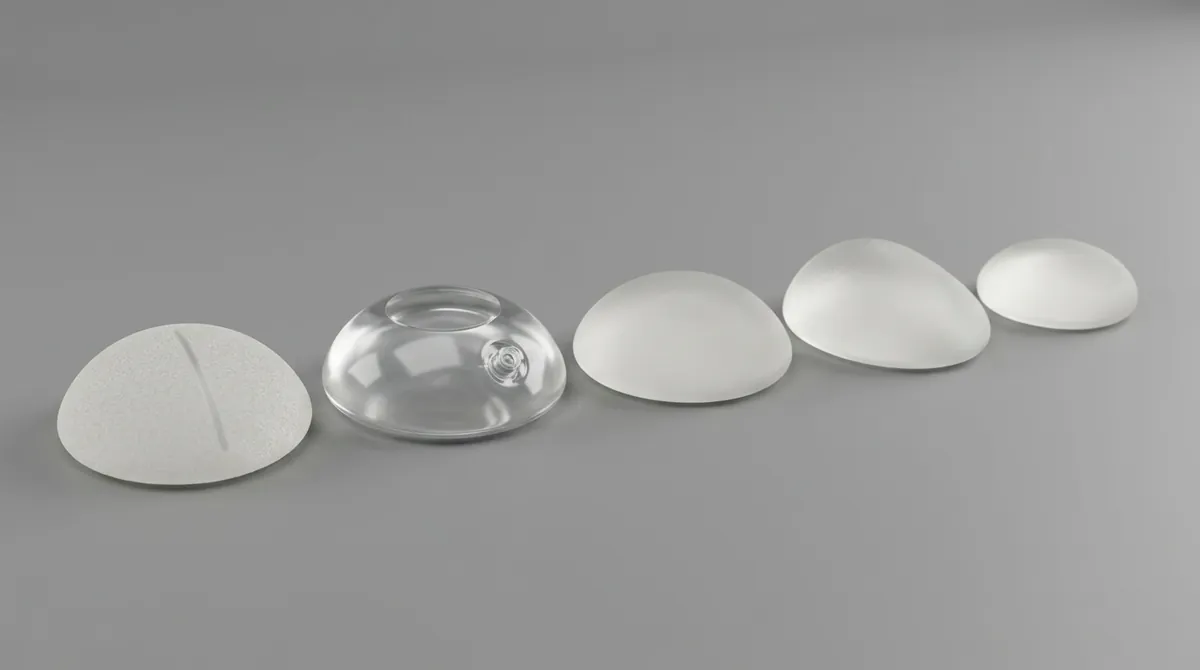
Silicone gel implants are the most commonly chosen breast implants in the UK, and for most patients they are the default recommendation. The reason is simple: the soft, cohesive gel inside them closely mimics the feel of natural breast tissue, giving a result that looks and feels convincing. This guide explains how silicone implants are constructed, why they are so widely used, the trade-offs to understand, and how to care for them over the years.
How silicone implants are made
A modern silicone implant has two parts: a durable outer shell and a soft filler. The shell is built from several cross-linked layers of silicone elastomer — a flexible, rubber-like material — engineered to be strong yet soft, so the implant holds its form while still feeling natural. Inside sits a cohesive silicone gel. "Cohesive" means the gel is cross-linked so it behaves as a soft solid that holds together, rather than a free-flowing liquid. Manufacturing standards for shell thickness and gel cohesivity have tightened considerably over the decades, which is why modern implants are more robust than early designs.
Degrees of cohesivity
Silicone gel is not all the same firmness. It ranges from softer cohesive gels that prioritise a natural feel, through to highly cohesive "gummy bear" gels that are firmer and "form-stable", holding their shape even when compressed. Your surgeon balances softness of feel against control of shape when recommending a gel firmness for you.
Why silicone is so widely used
- Natural feel. Cohesive gel is generally softer and more natural to the touch than saline.
- Shape retention. The gel keeps its form, contributing to a stable, natural appearance.
- Gel containment. Because the gel holds together, it limits the spread of silicone if the shell is ever damaged.
- Choice. Silicone implants come in the widest range of shapes, profiles and sizes, giving surgeons flexibility to match your anatomy.
Trade-offs to understand
- Incision length. Silicone implants are pre-filled, so they need a slightly longer incision than saline implants, which are filled after placement.
- Silent rupture. Because cohesive gel stays together, a rupture may cause no obvious change — a "silent" rupture. This is why imaging is sometimes recommended (see below).
- Cost. Implant prices vary by brand and type, which feeds into the overall cost.
Detecting silent rupture
Because a silicone rupture may not be obvious, some guidance recommends periodic imaging to check the integrity of silicone implants. MRI is the most sensitive test, and ultrasound is also used. If you notice a change in shape, new firmness, lumps or discomfort, see your surgeon. For routine long-term monitoring, discuss the right approach for you. See long-term recovery.
Caring for silicone implants long term
- Keep your implant card with the make, model and batch, and ensure your details are in the national registry.
- Get to know how your breasts normally look and feel, and report changes such as firmness, lumps, pain or one-sided swelling.
- Continue routine breast screening and always tell staff you have implants, so appropriate views are used.
- Remember implants are not lifetime devices — some future surgery is likely. See implant longevity.
Frequently asked questions
Are silicone implants safe?
Silicone implants are regulated devices meeting strict UK safety standards, and most people have no serious problems. They are not risk-free or lifelong, however — see our guide on whether breast implants are safe for the full picture.
How will I know if a silicone implant ruptures?
You may not notice, because cohesive gel can stay together (a 'silent' rupture). That is why imaging — MRI is most sensitive, ultrasound is also used — is sometimes recommended to check integrity. Report any change in shape, firmness or lumps to your surgeon.
What is a 'gummy bear' implant?
It is a highly cohesive, form-stable silicone implant whose firm gel holds its shape even when compressed. These are valued for shape control and are often used in anatomical designs, but feel firmer than softer cohesive gels.