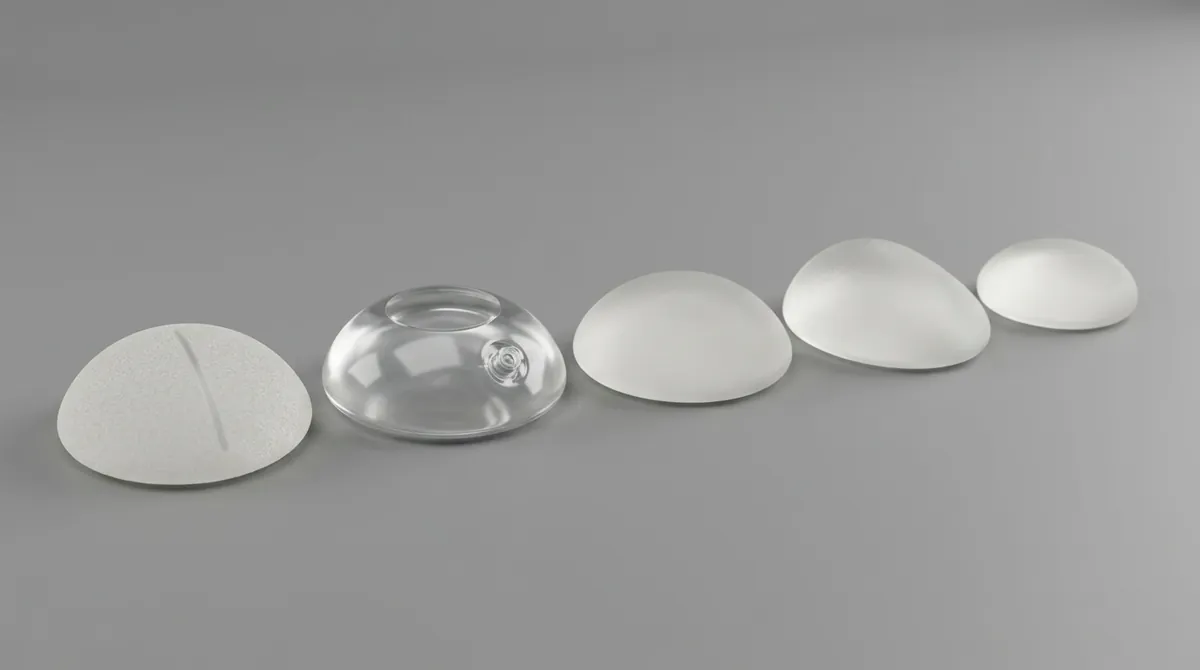
Breast implants are medical devices placed in the breast to increase volume, improve shape or restore fullness that has been lost through pregnancy, weight loss, ageing or previous surgery. They are used in cosmetic breast augmentation, in reconstruction after mastectomy, and in revision surgery to replace or exchange older implants. Despite the variety of products on the market, almost every modern implant is built around the same two ingredients: a durable outer silicone shell and a soft filler held inside it.
What a breast implant is made of
The outer shell of a modern implant is constructed from several cross-linked layers of silicone elastomer — a flexible, rubber-like material — together with a small silicone patch and the filler inside. The shell is engineered to be strong yet soft, so the implant holds its form while still feeling natural to the touch. Manufacturing standards for shell thickness and filler consistency have tightened considerably over the decades, which is one of the main reasons modern implants are more robust than early designs.
The two main fill types
There are two broad categories of breast implant, defined by what sits inside the shell:
- Silicone gel implants. These contain a soft, cohesive silicone gel inside the silicone shell. They are the most commonly used implants in the UK because they tend to feel the most natural and are available in a wide range of shapes and projections. Cohesive gel holds together even when the shell is cut, which reduces the spread of gel if the shell is damaged.
- Saline implants. These have the same silicone outer shell but are filled with sterile salt water (saline). Saline implants are used much less frequently in the UK. A structured saline implant adds an internal supporting structure to give a more natural feel than a simple saline-filled shell.
Cohesive gel itself comes in different firmnesses. Highly cohesive or “form-stable” gels — sometimes nicknamed “gummy bear” implants — retain their shape even when compressed, which gives surgeons more control over the final shape and is often used in anatomical (teardrop) designs.
Shape, profile and surface
Beyond the fill, three further design choices shape how an implant looks and behaves:
Shape
Implants are made in round and anatomical (teardrop) shapes. Round implants tend to add fullness to the upper part of the breast, while anatomical implants are designed to mirror the natural slope of the breast, with more volume towards the bottom. Some manufacturers also offer ergonomic designs that aim to behave more like natural tissue as you change position.
Profile
Profile describes how far an implant projects forward relative to the width of its base. The same volume can be delivered as a wider, flatter implant or a narrower, more projecting one. Profiles are commonly described as low/moderate, moderate-plus, high and extra-high. Matching the profile to your chest width is central to achieving a balanced result.
Surface
Implant shells can be smooth or textured, with newer micro-textured and nano-surface technologies sitting between the two. Surface type influences how the implant interacts with the surrounding tissue. This is an area of active research, partly because implant surface has been studied in relation to certain rare complications.
How implants have evolved
The first silicone gel breast implant was developed by American surgeons Thomas Cronin and Frank Gerow with Dow Corning, and the first augmentation was carried out in 1962. That first-generation device was an anatomically shaped implant with a thick shell and fixation patches on the back. Early implants had relatively high rates of capsular contracture (firm scar tissue around the implant), attributed to the shell quality and the gel of the era.
Second-generation implants in the 1970s used thinner shells and less viscous gel, which improved feel but increased silicone “bleed” and rupture rates. From the mid-1990s, semi-solid cohesive gels largely solved the problem of gel leaking and migrating outside the implant. Today's implants are the product of decades of refinement in shell construction, gel cohesivity and surface technology.
How breast implants are regulated in the UK
Breast implants sold in the UK are regulated medical devices and must meet strict safety and quality standards, overseen by the Medicines and Healthcare products Regulatory Agency (MHRA). Implants must be tested for safety and effectiveness before they can be placed on the market, and surgeons and manufacturers are expected to report adverse incidents.
The UK also operates a national Breast and Cosmetic Implant Registry. The registry records the implants used, the patient's details and the surgeons and organisations involved, so that patients can be traced and informed if a particular implant is ever recalled. Asking your surgeon to record your implant details — and noting the make, model and batch yourself — is a sensible part of any procedure.
Are breast implants safe?
Breast implants are among the most studied medical devices, and most people who have them do not experience serious problems. However, no implant is risk-free or designed to last a lifetime. Recognised risks include capsular contracture, implant rupture or deflation, infection and the possible need for revision surgery in future. There are also rare conditions specifically associated with implants, including Breast Implant-Associated Anaplastic Large Cell Lymphoma (BIA-ALCL), and a range of symptoms some people report under the umbrella term “breast implant illness.”
The honest position, reflected in current MHRA guidance, is that breast implants meet strict safety standards but are not without risk, and research into long-term outcomes continues. Understanding both the benefits and the limitations — and discussing them with a qualified surgeon — is the best foundation for an informed decision. Our dedicated guide, Are Breast Implants Safe?, explores the evidence in more depth.
Key takeaways
- A breast implant is a silicone shell filled with either cohesive silicone gel or saline.
- Silicone gel implants are the most commonly used in the UK because they feel the most natural.
- Shape (round vs anatomical), profile (projection) and surface (smooth vs textured) all affect the result.
- Implants are regulated by the MHRA and recorded in a national registry, but they are not lifetime devices and carry recognised risks.
- Always confirm the exact implant type, brand and model with your surgeon and keep your implant details.
References & further reading
- Medicines and Healthcare products Regulatory Agency (MHRA) — Breast implants and anaplastic large cell lymphoma (BIA-ALCL)
- MHRA — Symptoms sometimes referred to as breast implant illness
- NHS — Breast enlargement (implants)
- BAAPS / BAPRAS / ABS — Breast augmentation patient guide
- Maxwell GP, Gabriel A. — The Evolution of Breast Implants
- The history and development of breast implants — PMC review