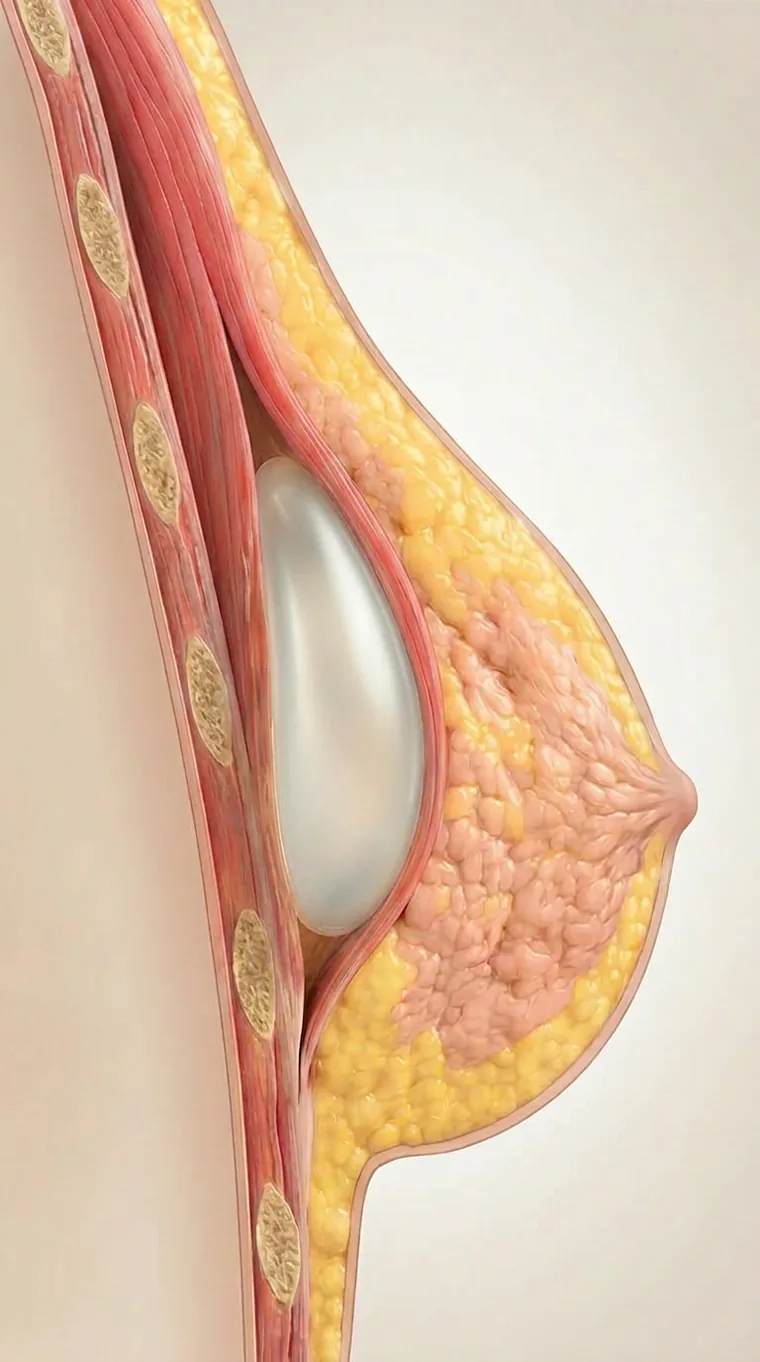
Dual-plane augmentation is the most commonly used implant placement technique in modern breast surgery, and for good reason: it is designed to capture the advantages of both over-the-muscle and under-the-muscle placement while minimising their drawbacks. In a dual-plane approach, the upper part of the implant sits beneath the chest (pectoralis) muscle, while the lower part sits directly under the breast tissue. This creates a dynamic, well-balanced relationship between implant, muscle and breast.
Why dual-plane is so popular
Dual-plane placement is widely favoured because it addresses the classic compromise in implant surgery — cover versus naturalness:
- Good upper-pole cover. The muscle over the top of the implant provides a layer of soft-tissue cover, reducing visible implant edges and rippling, particularly valuable in slimmer patients.
- Natural lower pole. Because the lower implant sits under the breast tissue, the lower breast can expand and redrape naturally over the implant, giving a smooth lower-pole contour and reducing the risk of double bubble.
- Lower capsular contracture rates. Partial sub-muscular placement is associated with lower rates of capsular contracture than purely subglandular placement in much of the evidence.
- Implant stability. Partial muscle cover helps hold the implant in position.
The dual-plane grades (I, II and III)
Dual-plane is not a single technique but a spectrum, graded by how much the muscle is released along its lower border — which determines how far the breast tissue can redrape over the implant. The surgeon tailors the grade to your tissue:
- Dual Plane I — minimal release, for firmer breasts with tissue concentrated above the fold (often younger, first-time patients).
- Dual Plane II — moderate release, for slightly looser tissue or a more mobile gland.
- Dual Plane III — the greatest release, for looser, more glandular or mildly sagging breasts, or constricted lower poles such as some tuberous breasts.
Judging the right grade — and the precise amount of muscle release — is a core surgical skill that strongly influences the result.
The trade-offs
No placement is perfect. The main trade-off with dual-plane is some degree of animation deformity — movement or temporary distortion of the breast when the chest muscle is flexed — because part of the implant sits under the muscle. This is usually less pronounced than with full sub-muscular placement, and many patients are not troubled by it, but it can be noticeable in very active or muscular people. Those who heavily train the chest, or for whom animation is a particular concern, may discuss over-the-muscle or subfascial alternatives. Early recovery also tends to involve a little more discomfort than over-the-muscle placement, because the muscle is involved.
Who is dual-plane right for?
Dual-plane suits a very broad range of patients, which is part of why it is so widely used — from slim, firm-breasted first-time patients (Dual Plane I) to those with looser or mildly sagging tissue (Dual Plane II–III). The flexibility of choosing the grade lets the surgeon adapt the technique to your anatomy. As always, the best placement for you is decided together with your surgeon after assessment. See which implant plane is best?
Frequently asked questions
Is dual-plane better than under or over the muscle?
For many patients, yes — it combines the upper-pole cover of sub-muscular placement with the natural lower pole of subglandular, which is why it is so widely used. But the best plane depends on your tissue, goals and lifestyle. See our 'which plane is best?' guide.
Will I get animation deformity with dual-plane?
Some movement of the breast on flexing the chest muscle can occur, because part of the implant sits under the muscle. It is usually less pronounced than with full sub-muscular placement and many people aren't bothered by it, but it can be noticeable in very active individuals.
What do Dual Plane I, II and III mean?
They describe how much the muscle is released along its lower border, allowing more breast tissue to redrape over the implant. I is minimal release (firmer breasts), III is the most (looser or mildly sagging breasts). The surgeon chooses the grade to suit your anatomy.